skip to main |
skip to sidebar
I'm currently working on a revision of the Architecture of Learning Basic Course. In an apparently analogy-minded moment, I wrote the following Introduction to the Course Book: 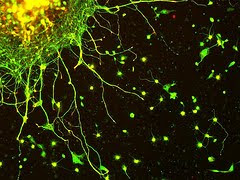 Why is effective teaching such a challenge?
On its surface, teaching seems like a simple activity. The teacher teaches, explaining or demonstrating some new concept or skill, and the student learns, absorbing and remembering the new material.
Watch what happens when we apply that same perspective to a different profession. On its surface, performing surgery seems like a simple activity. The surgeon operates, opening a human body and repairing or removing some internal malady, and the patient cooperates, showing up in the operating room and healing nicely when all is said and done.
Reduced to this level anything appears deceptively simple. However, every surgeon knows that operating is far more complex than this description suggests. Likewise, every teacher knows that fostering learning requires more than an explanation or demonstration provides.
Why? Because the human brain is not a computer; input≠output. On its way to becoming a recallable memory, new data passes through an embodied brain—a world of dazzling networks and constant activity. This world provides the setting for learning’s dance. The ballet begins, and dancers enter and exit as concepts blend and patterns emerge. Past experiences come out of storage to mingle with new data entering the stage via the senses. If the dance continues, the new data transforms into meaningful memories that can be called out of storage for future performances. This improvisational movement is learning. The teacher’s task is to provide the music that sparks this neuronal dance.
Now teaching does not seem so simple, does it?
In addition to the complexity of students’ inner worlds, external elements further complicate our work. Technology offers us an immense and ever-growing collection of tools—many of which feature enough bells and whistles to qualify as computerized cacophony if not used effectively. How do we design teaching that uses the best tools at optimal points in learning’s unplanned choreography?
Kevin Kelly, a writer and observer of “cyberculture,” offers a helpful insight: “Complexity that works is built up out of modules that work perfectly, layered one over the other.” This quote works well as an explanation of Architecture of Learning. Strands that possess an inner consistency are layered according to focus. As the focus shifts from one “layer” to another, students engage in the mental activities that compose learning’s dance. The Architecture of Learning Blueprints help the teacher select and sequence “music” that awakens students’ neurons.
You are invited to join learning’s dance. As you move through this course, think deeply about the ideas you encounter. Have the courage to try new approaches. Permit yourself to become a learner—a student—as you enrich your professional capacity to design instruction.
Then return to teaching, recognizing the challenge, but eager to invite your students to the life-changing dance that is learning.
Hoping you've invited your students to the dance today!
Photo credit:
If you’ve ever swum in a hotel swimming pool, you’ve likely seen the sign: “No diving! Water  depth is too shallow.” The pool is not deep enough to allow safe diving, and the fear, of course, is that the hotel will be sued if swimmers injure themselves by diving head-first into the pool.
It is probably a good policy for hotels, but not for constructing lasting learning. According to memory researchers, depth of processing increases retention. Why? Because deep processing “allows a richer and more elaborate code, which in turn becomes more readily available.”1 This idea is not a new one. In 1890, William James wrote: “The one who thinks over his experiences most, and weaves them into systematic relations with each other will be the one with the best memory.”2
The message: to make learning memorable, engage students in deep thinking about new material. But what constitutes deep thinking in new learning? Research suggests two mental activities, comprehension and elaboration.
Comprehension involves organizing new data. “During comprehension, the brain sorts, labels, and organizes the raw sensory data.”3 As teachers, we often organize material as we prepare to present it to students. However, the research claims that the students must label and sort new material themselves to increase the likelihood of retaining it. Even if students replicate the teacher’s organization of the material, the act of sorting and labeling the data themselves contributes to learning. Learning is somewhat like medicine. If the teacher takes the medicine, it does the student little good. But when the student takes the medicine, when the student thinks deeply about new material, the medicine can work as intended.
So, what does comprehension look like in the classroom? Students manipulating representations of ideas into structured schemes, such as tables, sequences, hierarchies, or even stories. For example, after explaining and modeling the steps involved in eliminating unneeded or ineffective modifiers from writing, a teacher may have the students develop flow charts to illustrate and sequence the steps. Naturally, the teacher presents and models the steps in their correct order, but having the students sequence the steps engages them in one aspect of the deep processing that promotes retention and recall.
This is also true of deep thinking’s second mental activity, elaboration. Elaboration “involves linking the material being rehearsed to other material in memory.”4 The term conceptual blending aptly describes elaboration. “The brain receives and sorts sensory data causing patterns to emerge. The patterns direct the brain to search its long-term memory stores for previous experiences that illustrate similar patterns…Once recalled, the previous experience provides a reference point for further thinking about the newly received data.”5 Understanding develops as a student recognizes relevant connections between the reference point and the new data, and “blends” these ideas.
What does elaboration look like in the classroom? “Increasing the variety of ways the brain processes information (e.g., both verbal and nonverbal) increases connections between new and known information.6 Learners deepen their understanding of new information by representing it in varied forms.” Howard Gardner’s multiple intelligences offers a way to vary the ways students interact with material. For example, during an earth science unit, a teacher may challenge students to find or create music that illustrates volcanic eruption or create personified accounts in which a volcano shares its goals, fears, and strengths as it prepares to erupt. “Note what such tasks require of the learner. Significant connections between the new material [e.g., volcanic eruption] and a nonverbal reference point [e.g., music] must be explored.” Such exploration engages learners in deep processing of the new material. “The resulting connections, which stem from the student’s life experience, create a conceptual network that gives him greater flexibility in thinking.”7
Unlike a shallow swimming pool, when it comes to learning, diving deep is good for one’s head! Notes
- Baddeley, A., Eysenck, M.W., & Anderson, M.C., Memory (New York: Psychology Press, 2009) 102.
- Ibid. quoted on p. 102.
- Washburn, K.D., The Architecture of Learning: Designing Instruction for the Learning Brain (Pelham, AL: Clerestory Press, 2010) 8.
- Baddeley, 103.
- Washburn, 14.
- deWinstanley, P. A., & Bjork, R. A., “Successful Lecturing: Presenting Information in Ways that Engage Effective Processing,” in Halpern, D. F., & Hakel, M. D. (Eds.), Applying the Science of Learning to University and Beyond, vol. 89 (San Francisco: Jossey-Bass, 2002).
- Washburn, 21.
photo credit: englishpianobloke (Flickr.com)
But time keeps flowing like a river (on and on)
To the sea, to the sea
’til it's gone forever…
At least that’s what the Alan Parsons Project suggested in their hit song. But poets and songwriters aren’t the only ones seemingly consumed by the passage of time. Educators frequently talk about the concept, discussing “time-on-task,” school start and end times, and the length of the school year. What’s behind this preoccupation with instructional time? Does it matter if the school day is interrupted for pep rallies, award assemblies, announcements from the office, and the like? Isn’t the school calendar that revolves around the needs of an agrarian culture adequate for today’s students? Why does nearly every conversation with teachers end up being a discussion of time and the lack of it in classrooms?
Teachers have sound reasons for being concerned about time. More than 100 years of research suggests a significant correlation between time spent learning and the amount of learning that results. As memory expert Alan Baddeley describes it, “In short, as far as learning is concerned, you get what you pay for.”1 The relationship between this research finding and teaching may seem obvious, but let’s dive deeper into the research and its implications. Researchers originally connected expertise in playing the violin with the amount of time spent in individual practice. They found that experts spent more than 10,000 hours practicing, while lesser experts spent about 7500 hours practicing, accomplished experts spent around 5000 hours practicing, and committed amateurs spent around 1500 hours practicing. While the numbers fluctuate slightly, the general range has remained surprisingly consistent as researchers examined expertise levels in other disciplines.2
What does this have to do with teaching? Probably more than we realize. For example, every school system I’ve encountered has significant literacy goals for students. Most schools would like to produce expert, or at least lesser expert or accomplished, readers. According to the research, developing such readers requires at least 5000 hours of practice—5000+ hours that students focus on applying and developing their reading capacity. With that in mind, let’s examine a possible scenario. If a child spends one hour each day for 175 days of the school year from grades one through eight, she will have invested approximately 1400 hours in developing reading expertise—not even enough for “committed amateur” levels! What if we add kindergarten and high school? The student still comes up woefully short at 2275 hours—not even halfway to accomplished levels.
No, this doesn’t include the time a child may spend reading at home, but it would be a rare child who actually spends the extra 2300+ hours needed to achieve “accomplished expert” levels. And to make the situation more challenging, recent research on the amount of time students actually spend reading in school classrooms ranges from a low of seven minutes to a high of 23 minutes.3 (Note that the research focuses on time spent practicing—recalling and applying skills—not on the amount of time the teacher presents information.)
Admittedly, we are not attempting to produce readers for the stage at Carnegie Hall, but this research on time and learning should not be dismissed. Time spent learning does matter for a student’s achievement. We’ve only explored this connection to developing literacy capacity, but the same would be true if applied to other disciplines. Want to develop expert mathematicians (or at least “committed amateur” mathematicians)? Time matters. Want to develop accomplished scientists (or, again, at least “committed amateur” scientists)? Time matters. The time a child spends recalling and applying learning correlates with the child’s level of expertise. When it comes to learning, time invested in recalling and applying relates to ability and achievement.
In conclusion, here are some questions to consider: - What are our priorities? In what areas of the curriculum are we attempting to develop more than amateur capacity? In what areas of the curriculum are we striving for more than amateur achievement?
- How does our time (both given and devoted) reflect those priorities?
- What is needed to increase the time students choose to spend in recall and application of new learning?
- What are the implications of this research for our own professional development?
Share your thoughts and insights!
References
- Baddeley, A., Eysenck, M. W., & Anderson, M. C. Memory (New York: Psychology Press, 2009), p. 70-78.
- Ibid.
- In-School Independent Reading. http://www.eduplace.com/rdg/res/literacy/in_read3.html
Every teacher experiences the frustration. Content and skills taught throughout the year seem to abandon students during springtime standardized testing. “How can they not know this?” thinks the the teacher. “We learned this back in November.”
 Recent research reveals some likely causes, and the principles for retaining new learning may not be intuitive to us as teachers. For example, multiple retrievals rather than multiple exposures promote better retention of new learning.1 In other words, the more students are required to recall new content or skills, the better their memory will be. Reviewing the material with students does not have the same effect. The students must be engaged in activity that requires them to recall the material. Even when students recall details incorrectly, if the teacher promptly provides the necessary instructive feedback, engaging students in recall of the material fosters better retention of new learning than a teacher-led review.2
But how often should teachers be engaging students in recall of newly learned material? Two findings provide answers.
First, repeated recall should occur frequently immediately following new learning. For example, a teacher who teaches students to add fractions should engage students in recall and use of that material several times over the school days immediately following instruction. Again, even if students do not recall the skill correctly, requiring recall combined with immediate instructive feedback is more effective than reviewing the skill.3
Second, once the initial period of learning and multiple retrievals is past, students still need to be engaged regularly in recall of the material. In general, students need to recall the material after a delay of 10 to 20% of the time between initial learning and final testing.4 For example, if students learn a new skill with only a month of school (about 20 school days) remaining, they should be engaged in recall of that skill every 2-4 days. This increases the likelihood that the new learning will be part of their knowledge when they begin the following school year. (Ideally, they would be recalling that skill every 7-14 days over a 10-week summer break!)
So, let’s go back to our opening scenario: a teacher teaches material in November that students need to recall for testing in May—a gap of about six months, or about 120 school days. To increase the likelihood that students will recall the material in May, they should be engaged in retrieving it every 12-24 days, once or twice a month, probably closer to every 12 days for the first few months and every 24 days for the last few months. It is critical that every retrieval be accompanied by immediate instructive feedback.
One more principle helps us design activities that engage students in retrieving new learning. The more material students are required to recall, the better. For example, if students are required to retrieve or construct an explanation of how to add fractions and actually apply the skill to add fractions, their retention will be greater than if they are merely required to apply the skill.4
According to this research, many of our classrooms may be structured for minimal memory retention. If we begin every school year reviewing material from the previous years and spend the second half of the school year introducing new material, students are less likely to retain the new learning in future school years because they were not engaged in recalling it throughout the school year. We need to be teaching more new material at the beginning of the school year and reviewing that material as the school year progresses. Perhaps this helps explain another common teacher frustration: the “They should have learned this last year” syndrome that we’ve all experienced.
Retrieval + Instructive Feedback = Retention of New Learning.
- Devachi, L. The Limits of Memory: How to Maximize Your Memory Trace. Presented at the 2008 North American Neuroleadership Summit, New York.
- Baddeley, A., Eysenck, M. W., & Anderson, M. C. Memory (New York: Psychology Press, 2009), p. 70-78.
- Ibid. 74.
- Ibid. 82.
Authors and illustrators get treated like rock stars at the National Book Festival. Readers crowd into tents, some literally with standing room only, to see and hear the people behind favorite narratives and artwork. The payoff is worth the effort. Many authors and illustrators are as interesting in person as they are on paper.
In the last post, I discussed three authors and illustrators who provided insights related to teaching. Here are three more who similarly challenged and inspired me.
Sharon Creech was, in honesty, quite different from what I expected. I’m not sure what I expected, but it wasn’t an author who would embody one of her characters so perfectly that you felt like you were in theater with an accomplished actress rather than under a tent with a writer. Her editor shared the stage and played a role as Mrs. Creech read and enacted a section from her latest book, The Unfinished Angel. With drama and humor, the two wordsmiths captivated the crowd, even those beyond the tent’s borders. (By the way, for the record, unfinished angels speak in English with an Italian accent and make up words when necessary!)
Drama and humor. Tension and laughter. What a great combination for teaching. When I prepare to teach, do I look for the drama and humor in new material? Do I use these tools to not only keep attention but make material more memorable? Do I go the extra mile to bring such creativity to my teaching? I love this quote from Saul Bellow: “No school without spectacular eccentrics and crazy hearts is worth attending.” Do I allow myself to be the “spectacular eccentric” or “crazy heart” when doing so would promote learning?
Up next, another Newbery-winning author, Kate DiCamillo. I must highlight the perseverance DiCamillo personified. When rain knocked out power to the sound system, she continued to take questions and shout answers to the audience. This sounds less of an accomplishment than it actually was. The tent was jam packed and people wandered through steady rain falling outside.
But it was DiCamillo’s anecdote about the origins of The Tale of Despereaux that captivated my thoughts. A young boy suggested a story about a hero with large ears. At first, DiCamillo didn’t give the suggestion much thought. It certainly wasn’t much to go on when trying to write a whole book! But the idea stayed with her, and about five years later, The Tale of Despereaux was published.
Simply listening to students can sometimes provide substantial professional development! In trying to teach a group new concepts recently, one individual kept asking for examples. Every time I’d thoroughly explain something, at least in my own thinking, I’d get asked for an example—sometimes more than one. Listen to the suggestion, I told myself. Keep it in mind. Use it to improve your teaching. As I responded with examples, I could see the a-ha! moments multiply. The request, when fulfilled, made me a better teacher.
Sometimes a suggestion, even one focused on a hero with large ears, is all the you need to communicate in fresh and effective ways.
Finally, my favorite presentation came from Jerry Pinkney. Mr. Pinkney is a five-time Caldecott Honor medalist, and his latest book, a retelling of the Lion and the Mouse fable through illustrations, should catch the committee’s attention this year.
 Mr. Pinkney shared his childhood with the audience. Growing up in the Philadelphia area, his parents, neither of whom possessed artistic talents, encouraged all their children to draw. It was something to do—something to keep the children occupied. While young Jerry manned a newspaper stand, an artist caught a glimpse of his sketches. Impressed, the artist invited Jerry to his studio. Before that visit, Pinkney was unaware that art was something you could do for a living, and oh!, the world of colors and artist’s tools that he encountered for the first time.
One caring adult—that’s it, just one caring adult opened up the world that would become Jerry Pinkney’s focus and passion. There’s a thought for teachers, but that’s not the one that I carried away with me.
Almost in passing, this successful, revered, and award-winning illustrator mentioned that he still takes drawing lessons. “You can always improve some aspect of what you do,” he explained, “and it’s important that you do so.”
While I can’t sign up for weekly teaching lessons, I can seek out professional development opportunities that will stretch some aspect of my teaching. Such continual growth is what Jerry Pinkney claims has empowered his success for several decades. My relevance and influence as a teacher may, likewise, depend on my willingness to continue growing professionally.
Drama, humor, wisdom, and growth. Sounds like a good recipe for teaching. In fact, it’s not a bad recipe for life.
The single shot from the starter pistol stirred me out of my pre-race stupor. Here we go, I thought. This is what those early morning runs prepared you for—hopefully. As I started moving toward the starting line of the Montgomery Half-Marathon (it took 27 seconds to get to the starting line!), Paul’s admonishment to run the race set before you infiltrated my thoughts. The race set before you. Reflecting on that concept brought to mind the advice friends had offered. Start out slower than you want to ultimately run. Use your head, especially for the first five miles. Be aware of other runners and avoid impeding their running. Take advantage of every water station. I shook them from consciousness and tried to focus on running my race.
That sounds easy, but doing it becomes much more difficult when you are surrounded by hundreds of other runners. How do you run your race when you are one drop in a moving wave? To be honest, I never figured it out, and for the first three miles I allowed myself to just be part of the wave. At the third mile marker, the wave became more like separated ripples, and I noticed that I was ahead of my target pace. Good news, right? Maybe. My concern then became having the stamina to finish the distance of 13.1 miles.
I kept trying to slow myself down. I even found a runner with a watch who was trying to run my target pace. I stayed behind him for a couple minutes, but couldn’t stand it and ended up passing him. At this point it became clear to me that running my race would depend mostly on listening to my body and heeding its suggestions.
I must pause to tell you about the funniest part of this experience. I’m an avid reader of Runner’s World magazine, and 99% of the advice I recalled from its pages proved true during the race. However, the RW writers made drinking from a tiny paper cup while continuing to run sound as easy as walking and chewing gum. As I entered the first water station I knew not to stop. That creates a major hazard for other runners (imagine a car stopping suddenly in front of you while driving). I knew to hone in on one volunteer, make eye contact, and grab and go. Shouting thanks was optional, but I managed it nonetheless. Now, just get the liquid into your mouth. Easy, right?
I pinched the cup, as I remember Runner’s World explaining, and tried “funneling” the water into my mouth. If the water in the cup had remained calm, all would have been fine. But my running served as a submerged earthquake, creating a tidal wave in my tiny paper cup. As I attempted to pour the water into my mouth, the tsunami continued its upward trajectory, soaking my entire face and adding to the muck on the inside of my glasses. Determined to do it right, I got brave at the second water station and grabbed a cup of sports drink. The same thing happened. My head was now drenched and dripping watery Gatorade. I stuck out my tongue to catch a few drops, laughed at myself, and kept running. It took me five water stations to get the motion right! Apparently, though my running pace was ahead of schedule, my learning pace was behind.
Somewhere around the five mile mark, I overheard the following conversation:
Runner A: Hey, Bob, I didn’t know you were a runner!
Runner B: I’m not! I just started in March. This is my first race. When I started I could only run 90 seconds before resting. Now look at what I’m doing! It’s crazy!
Runner A: No, not crazy. Awesome!
Like me, Bob was running his race. In six months, he’d gone from being a non-runner to running a half-marathon. What an inspiration!
I must pause to make an observation about people. Specifically, non-runners. Every once in a while, someone would be sitting out on their lawn and occasionally yelling to the runners. (Some might have yelled at us, but I often was too distracted to hear clearly!) I think at least six different people told me, “This is the last hill! It’s all downhill from here!” They were liars, every single one. Others would yell, “Keep going! You’re almost there!” Thanks, but at the four-mile mark of a 13.1 mile race, you’re not even close to being almost there.
However, many people really did provide a lift of spirits. On the campus of Alabama State University, the percussion section of the school’s marching band rhythm-ed us across the campus. In the Colonial Heights neighborhood, a group of neighbors stood at the corner shouting greetings and welcoming us to their home turf. At another point, a family had their car doors open and its radio blasting; the beat of Motown carried us on its waves. A gentleman on a bike showed up at several mile markers to cheer the runners forward. Each of these made me glad to be there. (I had quite the opposite reaction to whomever in “historic Cloverdale” thought it would be funny to cook bacon with all the windows open, but I’ll let that go!) Another activity that upped the friendly factor was the many runners who thanked the police officers and volunteers who made the event safe and smooth from beginning to end. I hope all of them knew the sincerity behind those yelps of gratitude.
Somewhere after the 10th mile marker, I lost track of how far I had gone. Was the next mile marker 11 or 12? I convinced myself it would be 12. Obviously, it wasn’t. I surprised myself by not being defeated or even set back too badly from this miscalculation. Somehow I was able to push ahead, glad to finally know for sure what the next mile marker would be.
And oh, the joy of hitting mile marker 12 and then 13 and noting that I was still ahead of my target pace. It was possible that in addition to finishing I might actually finish in under two hours! (Cue the Chariots of Fire theme!). “Hear those bells?” called a spectator. “They’re waiting for you at the end!” Again, technically the bells were not at the end, but they did pull me forward. In fact, as I rounded the last corner I found a burst of energy and actually sped toward the finish. Recalling Runner’s World’s recommendations again, I tried to ignore the clock and run through the finish so the photos of me would be magazine cover material. Let’s just say that between the Gatorade baths and the fact that I looked like I had just run 13 miles, I won’t be appearing at your newsstand anytime soon. Nonetheless, my wife did capture the moment, providing evidence of the accomplishment.
A few moments of chaos—a man with what looked like a pin-pong paddle stepped forward to scan my timing chip, a volunteer threw a finisher’s medal around my neck, and a couple volunteers offered water and bananas to the weary—and it was over. It was over way too soon. I was just beginning to have fun! There is little that generates more motivation than success.
By now you may be wondering what this has to do with education. After all, that is the focus of this blog. To make some connections, let me share some questions that I’ve asked myself:
- Do I recognize that my students must each run his/her own race to learning—that learning is always an individual act? How am I creating the conditions that allow each learner to find their way to new understandings and abilities?
- How do I lift the spirits of learners who find the going difficult? Do I toss easy lines at them? or do I encourage them with honesty while running along side them to help them progress?
- Do I allow and help my students to laugh at themselves? Failure combined with self-anger is a sure road to defeat. Do I model resilience? Do I help my students develop resilience?
- Do I recognize that what I think will be easy may be a challenge for students? Do I plan sufficient practice and feedback to support students as they move toward mastery?
- Do I celebrate students’ success? Do I create conditions that give students a feeling of accomplishment? or am I so preoccupied with the next thing that celebrations get left out? How motivating do I allow accomplishment—true accomplishment—to be?
These aren’t new ideas or the roadmap for major educational reform, but their potential power and influence are more significant to me than ever before. I may not have raced to the top (I finished 203rd), but running my own race proved to be an effective dose of professional development.
Authors and illustrators recently challenged my thinking about teaching.
 The National Book Festival is an annual event held on the Mall in Washington, D.C. This year my wife and I attended for the first time. As I listened to various children’s authors and illustrators, I was struck by how much relevance the ideas they communicated had for educators.
First up was Charles Santore. Mr. Santore has illustrated several well-known children’s books, including The Camel’s Lament and versions of classics, such as the poem “Paul Revere’s Ride” and the fantasy The Wizard of Oz. He also illustrated this year’s National Book Festival poster.
Because he moved from advertising illustration to children’s literature, many of Mr. Santore’s comments contrasted the two. For example, in illustration, Santore explained, you have to synthesize all the ideas into one, attention-grabbing illustration. However, in illustrating children’s literature, the artist can attend to pacing, even drawing “quiet” pictures that allow the reader to pause and ponder.
This pacing, giving the reader time to imagine and think, mirrors a pace the brain needs for optimal learning. Often called “down-time,” the brain needs to process new content in manageable chunks.1 A teacher who lectures for 45 minutes straight promotes less learning than a teacher who presents information for 10 minutes, engages students in processing new material, and then resumes presenting information for another brief period. To learn, the brain needs to pause and ponder—it needs the story of learning to include “quiet” illustrations.
Up next was one of my favorites: Nikki Grimes. Miss Grimes has authored several of my favorite children’s books, including The Road to Paris. With gifts in both poetry and prose, Miss Grimes captivated the audience with a colorful, poetic journey through several of her works. I cannot explain this sufficiently to help you appreciate it. She used poetry to introduce a color and its affective associations, then illustrated the concepts with passages from her writings. She created a hush in the tent and no one wanted her to stop.
What does this have to do with teaching? It made me think about how little thought I often give to my actual presentation of information. Sure, I think long and seriously about the activities I use to introduce or engage students in processing new information, but Nikki Grimes put that kind of thought into how she actually presented the information.
Hmm, how could I simulate this? Could I combine communication forms to better articulate critical concepts for students? Would a poetic journey through the Pythagorean theorem promote better understanding? One thing is certain: by challenging myself to consider the approach, I’d think more deeply about how I would actually explain the concept, and that would likely improve the words and phrases I used to teach it.
Finally, for this first of two posts, we heard and observed illustrator Kadir Nelson. Without exaggeration, Mr. Nelson is an artistic genius as evidenced in all his books, including the recent Testing the Ice.
A quiet individual, Mr. Nelson let his pens do most of the “talking.” He called two children up to the stage and recreated one of his illustrations with the children filling the roles of the original characters. Two young girls became Jackie Robinson and Yogi Berra, and their faces lit up with excitement and recognition. He actively involved the children, taking their minds to the scene he wanted them to imagine. Wow! In one illustration, he captured an entire narrative—a narrative to which two young girls could emotionally connect.
Narrative is a powerful teaching tool. Stories frame experience. Mark Turner suggests stories are actually fundamental, organizing structures: “Parable is the root of the human mind—of thinking, knowing, acting, creating, and plausibly even of speaking.”2 Neurologist and author Alice W. Flaherty agrees, suggesting metaphors, such as stories, contribute to memory formation and understanding: …metaphors are cognitively useful because they rephrase an abstract concept in more physical terms. This engages the cortex with its visual, auditory, tactile, and olfactory maps, and the limbic system with its emotional charge…[Metaphors] create a sense of understanding by an analogous mechanism. By giving abstract concepts tastes, colors, smells, and emotional resonance, metaphors fix them in our minds and make us feel like we understand them.3
The human mind frequently thinks in terms of stories, communicates in stories, and converts new learning into stories. By framing experience, stories provide a structure for exploring and making sense of experience. Can I structure any of my teaching as narrative? Again, just challenging myself to try will likely improve my teaching.
Pondering pauses, poetic presentations, and narrative frames can inspire and inform my teaching. What I learn from authors and illustrators can become personal professional development if I’m willing to accept the challenges their ideas present.
In Part 2, insights from authors Sharon Creech, Kate DiCamillo, and illustrator Jerry Pinkney.
- Sousa, D., How the Brain Learns, 2nd ed., (Thousand Oaks, CA: Corwin Press, Inc., 2001).
- Turner, M., The Literary Mind: The Origins of Thought and Language (New York: Oxford University Press, 1996), i.
- Flaherty, A. W., The Midnight Disease: The Drive to Write, Writer’s Block, and the Creative Brain (Boston: Houghton Mifflin, 2004), 230.


